ShareThis

Sunday, May 19, 2013

Fuel for Biofuel part 1

Figure 1: Illustration of bacterial ethanol (EtOH) production from corn by Natural Line Studio
Last month we took a look at ocean plastic. It was pretty depressing and from the point of view of microbiology,  a bit of a non-starter.  So lets go back to land and biofuels, one of the next great hopes that makes use of various micro-organisms.
 
Summarising the basics of the biofuel process
In order for micro-organism to produce biofuel (Figure 1) they need a food source or feedstock. Feedstocks are generally made of starch (Figure 2) or lignocellulose (fibrous parts of plants). These are polysaccharides of small subunits like monosaccharides or disaccharides, just like plastics are polymers of hydrocarbon monomers (see my January post). In Figure 2 each hexagon is a glucose (monosaccharide) molecule. A row of glucose molecule joined together, by glycosidic bonds, in this way is called amylose. When the glucose from the top row forms a bond with a glucose in the second row, it is called amylopectin. Therefore starch consists of amylose and amylopectin.
Figure 2. Structure of starch
The first step is to break up the polymers so that the maximum number of chemical bonds are exposed and available to micro-organisms.  Mechanical, heat and enzymatic action is used to achieved the breakdown of the polymers to edible chunks (monosaccharides and dissaccharides). These breakdown steps are followed by and often coincident with the fermentation step where micro-organisms use the released sugars as a carbon source to produce ethanol.You can imagine that the cost of this is not insignificant, so making it as efficient as possible is key. Biofuels include ethanol, butanol, biodiesel and a number of second generation fuels. Currently ethanol is the only commercially produced biofuel, a so-called first generation biofuel and we will start with this.

Ethanol
Ethanol is the main biofuel produced globally (Fisher et al,. 2008). Ethanol is an alcohol. Chemically, alcohols are denoted by a hydroxyl or -OH group (see structure in figure 3)
Figure 3: Ethanol
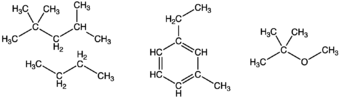
and it is added to petrochemical vehicle fuel to increase the octane number (see bottom of post for octane number explanation) and to cut down on smog inducing emissions. Flexible fuel vehicles have modified engines that are able to use mixed gasoline/ethanol as fuel. A common flex fuel is E85 (85% gasoline, 15% ethanol).  Sugar cane in Brazil and corn in the USA are the main feedstocks of bioethanol with very high conversion efficiencies (i.e. % of feedstock input converted to ethanol) of between 90-95%  (Fisher et al, 2008). The problems with ethanol is that it is rather different from gasoline. But hold on....just what IS gasoline or petrol? It consists of a mix of hydrocarbons called alkanes, cycloalkanes and olefins with 4-12 carbons in each molecule (Figure 4). Additives are also present to enhance the use of the fuel in an engine such as MBTE in Figure 4. Structurally and chemically, these molecules are quite different from ethanol.
Figure 4: Common components of gasoline

Since most cars can run on 10% ethanol mixed with gasoline, why does flexfuel only make up only 6% of fuel used (Solomon, 2010)?. The infrastructure present for piping gasoline around the country is extensive and obviously has taken considerable investment. Because ethanol can be corrosive to the materials of this infrastructure as well as to unadapted car engines (Fisher et al, 2008), a new infrastructure would be required specifically for flex fuel and adapting cars costs a couple of thousand dollars, something many people can't afford.

The other big problem is the use of corn as a feedstock despite its good conversion efficiencies. This is because, when considering the impact of feedstocks for biofuel, there are numerous factors to consider apart from the hopeful reduction in climate change gases. These include water use, land use prior to corn growth, biodiversity decrease, pollution of water and air due to growth (pesticides, fertilisers), processing (needs electricity from oil) and socio-economic impact. There have been numerous studies on corn as an ethanol feedstock with varying outcomes. The overall message that comes through is that although corn as a feedstock is better than using petrochemcials, it is unsustainable and even at maximum capacity, could only support 20-30% of biofuel needs of the US (Solomon, 2010). Though sugar cane as a feedstock fares better than corn, there are other feedstocks known as cellulosic (sometimes called lignocellulosic) material (includes paper, wood, cardboard, fibrous plant material) that have a much lower impact as they can come from waste products of current industries, not from the new growth of a dedicated crop. Interestingly, one of the main public concerns of corn as an ethanol feedstock is the increase in food prices as more land is devoted to corn for ethanol rather than corn for food. However the situation is more complex and in fact also depends on oil prices (Solomon, 2010). The % of corn that is used for food is the smallest of the corn uses at 10% and animal feed is the largest at 48%. Fuel takes up about 23% (Solomon, 2010).

So if cellulosic material is so much better, why aren't we already using that? The commercial popularity of corn is because cornstarch is readily available, a relatively simple polysaccharide (figure 2) and therefore more easily converted to ethanol. Cornstarch also makes up 70-72% of the dry weight of a corn kernal. Lignocellulosic materials have a more complex structure and requires more enzymes and different types of micro-organisms to digest it;  because of this, they are not yet commercially viable. I will discuss this in my next post but for now, lets get back to ethanol and the types of micro-organisms that are used to convert it to ethanol.

Ethanol producing micro-organisms
Saccharomyces cerevisiae also known as budding yeast or bakers yeast is the micro-organism of choice in commercial bioethanol production (Figure 5).  Zymomonas mobilis  has also been heavily studied but S. cerevisiae remains top bug, mainly because Zymomonas mobilis need a specific subset of monosaccharides in order to produce ethanol where as S. cerevisiae is less of a picky eater (Bai et al, 2008). Conversion of corn to ethanol can be done through dry milling (67% of ethanol is produced this way) or by wet milling (33% ethanol is produced this way).  Bothast and Schlicher, 2005 give an excellent summary as follows
Figure 5: Electron micrograph of S. cerevisiae

 "The wet milling process is more capital- and energy intensive, as the grain must first be separated into its components, including starch, fiber, gluten, and germ. The germ is removed from the kernel and corn oil is extracted from the germ. The remaining germ meal is added to fiber and the hull to form corn gluten feed. Gluten is also separated to become corn gluten meal, a high-protein animal feed. In the wet milling process, a starch solution is separated from the solids and fermentable sugars are produced from the starch. These sugars are fermented to ethanol. Wet mill facilities are true “biorefineries”, producing a number of high-value products. In the dry grind process, the clean corn is ground and mixed with water to form a mash. The mash is cooked and enzymes are added to convert starch to sugar. Then yeast is added to ferment the sugars, producing a mixture containing ethanol and solids. This mixture is then distilled and dehydrated to create fuel-grade ethanol. The solids remaining after distillation are dried to produce distillers’ dried grains with protein and are sold as animal feed supplement."

It is in the fermentation process that S. cerevisiae uses the released glucose in the respiratory process of glycolysis. Remember back to your school biology? Glucose is broken down to pyruvate with the coincident production of the energy rich molecule ATP. Pyruvate can have many fates but one of them that occurs under anaerobic conditions is the production of ethanol. In animals cells lactic acid is produced instead of ethanol. But we have a problem. In both wet mill and dry grind conditions, harsh conditions are used - low pH and accumulating ethanol.  Glycoamylase, one of the enzymes that is used to converts starch into glucose works well in a pH of 4.5 and is continuously added during the fermentation process to ensure that all startch is converted to glucose. Now S. cerevisiae is one of the bugs I have personal experience with. Generally a neutral to slightly acidic pH (between pH 5-7) is best for growth and optimum temperatures were 30-37 degrees Celsius depending on the experiment. According to Bohast and Schlicher, 2005, fermentation occurs at 32 degress Celsius (no problem there) but the pH can sink to below 4. Ethanol concentration reach between 10-12% which is toxic and osmotic pressure is also a problem. How do the industrial yeast manage?

Engineering yeast for biofuel production
To enable the yeast to be at maximum efficiency for converting glucose to ethanol, many changes can be made to its genome. S. cerevisiae is a model organism, meaning that it is widely used as a model for studying genetic and protein interactions from which inferences can be made about similar genes and proteins in higher eukaryotic cells such as our own. The genetic manipulation of S. cerevisae is well studied and has a wide repertory of molecular techniques which are much easier to perform than those  necessary for mammalian cells. So, what has been done to allow S. cerevisiae to cope with high ethanol production (here's where it gets a bit more technical....)

Increased tolerance to stress is a complex metabolic process and it is not usually the case that you can alter one gene and not affect anything else. Having said this, single gene manipulations have had some success. For example, increased expression of single amino acid transport systems have been shown to have protective effects and overexpression of the amino acid tryptophane permease genes (TRP1-5) have resulted in improved ethanol tolerance with little negative impact to growth. Other single manipulations of genes involved in uracil and galactose synthesis have also improved ethanol tolerance.

Examples of other approaches that affect many genes are directed evolution and global transcription machinery engineering (gTME). In directed evolution, yeast is exposed to fermentation conditions, cells that survive are grown up and rexposed to fermentation conditions. Different batches are made testing for high ethanol and heat resistance for example. In this way, advantageous mutations accumulate. Increases in ethanol tolerance of 62 fold and heat tolerance of 89 fold have been reported (Zhao and Bai, 2009). gTME is the introduction of a randomly mutated copy of a transcription factor that controls transcription of a large set of genes. The transcription factor will then alter the transcriptional controls  depending on where in the genome it is introduced. Subjecting the engineered yeast to fermentation conditions will result in the survival of those yeast cells with improved ethanol tolerance. For example - 69% more ethanol production has been reported on a laboratory scale using this method (Zhao and Bai, 2009). 

Another rather impressive aspect is the control of flocculation. Flocculation is the tendency of yeast to clump together. Self flocuclation is controlled by expression of certain genes and, by varying the stirring speed in the fermentor, the size of the floc can be also be controlled. Zhao and Bai, 2009 report on a study where the optimal floc size was found to be 300 um (micrometers) producing the highest cell viability when subjected to ethanol shock with concomitant improved ethanol yield. 

These are just some examples of how the yeast genetics can be manipulated to improve ethanol yield and you can see how industrial yeast  ends up being very different from the yeast used to brew beer or bake bread and also demonstrates the flexibility of this micro-organism. 

Conclusion
Here, I have talked about the use of corn as a feedstock for bioethanol and we have seen that it is likely not a long term solution to our energy woes. Several second generation biofuels are now being made from other feedstocks and with other micro-organisms. The use of corn is only the tip of the iceberg in terms of what is possible for the environmentally friendly production of fuel. Wait up for my next post to read about this!

Definition of octane number: Octane number (or rating) is a value used to indicate the resistance of a motor fuel to knock. Octane numbers are based on a scale on which isooctane is 100 (minimal knock) and heptane is 0 (bad knock).  
Examples: A gasoline with an octane number of 92 has the same knock as a mixture of 92% isooctane and 8% heptane.
Knock: compressed gasoline-air mixtures have a tendency to ignite prematurely rather than burning smoothly. This creates engine knock, a characteristic rattling or pinging sound in one or more cylinders

References
Bai, F. W., W. A. Anderson and M. Moo-Young (2008). "Ethanol fermentation technologies from sugar and starch feedstocks." Biotechnol Adv 26(1): 89-105.
Bothast, R. J. and M. A. Schlicher (2005). "Biotechnological processes for conversion of corn into ethanol." Appl Microbiol Biotechnol 67(1): 19-25.
Solomon, B. D. (2010). "Biofuels and sustainability." Ann N Y Acad Sci 1185: 119-134.
Zhao, X. Q. and F. W. Bai (2009). "Mechanisms of yeast stress tolerance and its manipulation for efficient fuel ethanol production." J Biotechnol 144(1): 23-30.


Wednesday, May 1, 2013

Farmed fish - pros and cons


A piece of information I really wanted to add to the last post (Plastic Oceans, April 2013) where I started off by talking about declining fish stocks are the pros and cons of eating farmed fish in order to preserve ocean fish stocks. An excellent review of this topic is given here. In summary, fish farming can be beneficial but needs to be carefully managed and  regulated because feeding farmed fish, managing their waste and keeping them contained can all become risks to the environment and consumer. As with anything you buy at the supermarket, if you can afford the time and energy to research where and how it arrives in the store, you can at least make more informed decisions.

Next post coming next week: Fuel for biofuel.....


Sunday, April 7, 2013

Plastic oceans

Figure 3. Bacteria and ocean plastic. Artwork: Mark W. Slater
You may have heard, lately, that fish stocks are rapidly declining. I thought this was something new, as in general knowledge in the last couple of years. Well, its not. In 2003, the National geographic published an article stating that fish stocks had declined by 90%. 90%. An article in 2011 by Juan-Jordá et al, (1) looked at tuna and its relatives and show a 60% decline in the last 50 years. Clearly, dear Readers, there is a problem and its pretty much slamming us in the face. Apart from overfishing, our old frenemy plastics has a large part to play.

What happens to plastic that enters the ocean? That plastic beach ball I let go of on holiday when I was 10 and that bobbed out to sea before we could get a hold on its slippery surface. Plastic used by the fishing industry, plastic accidentally or purposely dumped in the ocean, plastic from land use that finds it way from rivers to the ocean, dumping from commercial liners (to name a few) all make up the debris. The plastic that floats is swept around by the oceans currents and collects in gigantic slow moving pools including the 5 major oceanic gyres. The orgnanisation "5 gyres" has a great website showing the location of the gyres and how the plastic gets there. The debris is not visible from space as it is dispersed and often below the surface of the water but the concentration of plastic, chemical sludge and other debris in the open sea (also called the pelagic zone) is much higher than in non-gyre areas.

Figure 1. Potential pathwys of transportation of microplastics and its biological interactions (6)
Once in the water, numerous evils result (Figure 1). First plastic is weakened and broken down by several types of degradation: biodegradation, photodegradation (action from sunlight), thermooxidative degradation (slow oxidative breakdown at moderate temperatures) and hydroysis through reaction with water (2). It ends up breaking down further and further until it reaches sandsized and then microscopic particles. At this point it is in the neuston layer of the ocean which is the region at the surface and just below the surface of the water. Neuston can also be used to describe organisms that live in this region. For example, a water strider (UK: skater) is a neustonic organism. Neustonic plastic in the garbage patches reaches densities up to 7 fold higher than zooplankton - the small organims that drift in the ocean and are found at the start of the food chain.


You can easily imagine the danger to wild life of entangling fishing line or an ingested bottle cap. Study of birds, fish and other aquatic organisms find that they are loaded with plastic (Figure 2)(3,4,5). If this is the consequence of larger organisms eating plastic we can see by eye, what happens to the broken down plastic that we need a magnifying glass or microscope to see?  Microplastics are defined as plastic particles less than 5mm in size (6) and of course even small organisms can eat these. The authors of the article in (7) have conducted a study on the size, mass and type of plastic they found in testing 748 samples from the western North Atlantic Ocean and 88% was less then 10mm long. Smaller organisms can eat these particles and they in turn can be eaten by organisms further up the food chain. What happens to the eaten plastic? For the larger organisms such as fish, birds and even whales it can be lethal [Figure 2, (1-6)]. But what about  microplastics and  - wouldn't they just pass straight through?  As we've seen in the previous posts, during plastic manufacture, chemicals are added to change the properties of the the plastic to suit their end products or to make them more biodegradeable. Additionally, monomers that were not properly incorporated during polymer production, chemicals that result from breakdown and chemicals unrelated to the manufacture of the plastic but included as part of the product (e.g. detergents in household cleaners, engine oil etc) will also end up in the water - they are known as persistent organic pollutants (POPs) and can by highly toxic (2). Some of these chemicals have been found to adsorb to microplastics and therefore will also end up in organisms and probably become part of their cellular make up and work their way up the food chain [5 gyres website; (2)] and eventually, one would assume getting passed on to us.

Figure 2. Dead Laysan albatross chick with plastic in its stomach (1).
I'm only scratching the surface of this topic and since my topic in this blog has so far been micro-organsims but lets get back on task: do micro-organisms have anything to do with  microplastics? The straight answer is yes but not much. Of the 4 types of degradation mentioned above, biodegradation is the least contributory. It is certain that microplastics are colonized by micro-organisms (Figure 3) but they have little impact on their generation and how much they have to do with their further breakdown has not been studied - as far as I can see. They could of course feed off POPs that adsorb to the plastics and contribute to the chemical status of these as they exist in the oceans or are eaten by other organisms. There is some suggestion that the bacteria that colonize ocean plastic come from the Vibrio Genus (see this link for a summary and reference), which is also the Genus that causes cholera. Whether or not the species of Vibrio is pathogenic remains unknown.   

Considering how much plastic we use for the amount of time we have used it and our careless manners with regard to our planet, there must be a quite a bit of plastic in the ocean. I haven't been able to get a substantiated figure but according to CBS, Jim Oswald of the Marine Mammal Center in San Francisco, California, USA says 300 billion pounds or 150 million tons (or 43 million elephants!).

Is it all doom and gloom and no fish and chips? Is there anything we can do about it? YES - try to use less plastic! Much easier said then done but think about it. The best form of being green is to reduce consumption. Recycling is good but if there's no demand for your recycle material, it will still end up in a landfill or incinerator. Reusing is good too but reducing is best. I am starting to consider how I can reduce my plastic consumption. For example instead of buying a plastic tub of hummus to take to a gathering, I could make it myself with cans (tins) of garbanzo beans. I don't need to put my fruit and veggies in little plastic bags at the supermarket I shop at. I can search out farmers markets and bring my own reusable bag.  I was searching the internet and came across Beth Terry who blogs about living without or very little plastic on her my plastic free life. Would you take a look and adopt some strategies for reducing the plastic in your life and maybe, just maybe reducing your chances of being part of marine life destruction. All life is linked - if they suffer, we suffer, even if you only feel it as no tuna in the supermarket.

References.
1. Juan-Jordá MJ, Mosqueira I, Cooper AB, Freire J, Dulvy NK. 2011 Global population trajectories of tunas and their relatives. Proc Natl Acad Sci USA. Dec 20; 108(51): 20650-5
2. Andrady L. Microplastics in the marine environment, 2011, Marine Pollution Bulletin, 62, 1596-1605.
3. Young LC, Vanderlip C, Duffy DC, Afanasyev V, Shaffer SA (2009) Bringing Home the Trash: Do Colony-Based Differences in Foraging Distribution Lead to Increased Plastic Ingestion in Laysan Albatrosses. PLoS ONE 4(10)
4. Mrosovsky, N, Ryan GD, James MC, Leatherback turtles: the menace of plastic. 2011 Proc Natl Acad Sci U S A. Dec 20;108(51):20650-5.
5. Boerger CM, Lattin GL, Moore SL, Moore CJ. 2010 Mar Pollut Bull. Plastic ingestion by planktivorous fishes in the North Pacific Central Gyre. Dec; 60(12):2275-8
6. Wright S.L, Richard C. Thompson RC, Galloway TS. 2013 The physical impacts of microplastics on marine organisms: A review. Environmental Pollution. In press.
7. Morét-Ferguson S, Law KL, Proskurowski G, Murphy EK, Peacock EE, Reddy CM. 2010. The size, mass, and composition of plastic debris in the western North Atlantic Ocean. Mar Pollut Bull. 2010 Oct;60(10):1873-8.

__________________________________________________________________________________
Lifestyle magic: Reduce your plastic use.
Use reusable shopping bags (stash extra's in your car/backpack/briefcase, refill water bottles - metal, refill coffee cup (metal), buy from bulk bins for rice, grains etc, don't bag your fruit, go to farmer's markets if possible and bring your own bag. Write to your supermarket to reduce packaging. 


Thursday, February 28, 2013

This month has been extremely busy and more entertaining activities have had to be curtailed. I hope to post by the end of March. I'm sorry for the postponement. Keep being green!

Thursday, January 31, 2013

Plastic bugs


PLASTIC DEGRADATION - NOT THE NITTY GRITTY
Figure 1. Bacteria producing PHA. Art by Mark W. Slater
Here's where I thought we would get into some real biochemistry to explore the pathways involved in breaking down plastics. Turns out, the material gets a little heavy for the scope of this blog (lots of experimental conditions and little consensus) so there will be a little biochemistry and then we are going to turn to properly biodegradable plastics produced by micro-organisms. Lets first return to my favorite plastic, polyurethane and specifically the polyester type of polyurethane (PU) that is more amendable to bio-degradation (see the previous blog for help with understanding the why!).

It was evident from the beginning of polyurethane production and use, that the material was susceptible to fungal degradation. Tests were done with purified enzymes and in soil where fungal communities were discovered to have a number of PU degrading species. However the best results were obtained when a biostimulant was added such as Impranil DNT, a readily digestible form of  PU - sort of like baby formula for fungi. The addition of cultures of known PU biodegrading fungi was also helpful in increasing biodegradation of PU by native soil fungi. The enzymes were thought to be extracellular (i.e. pumped out of the fungus) and to be a combination of ones that could cut bonds in the middle of the polymer at random positions (endoenzymes) and those that chopped off monomers from the end of the polymer chain (exoenzymes). In general, an additive like yeast extract also needed to be added as a carbon source to create  more extensive degradation, though fungi that could utilize PU as the sole carbon source were identified (Howard et al., 2012) Recently, an endophytic fungus from the Amazon rainforest has been identified that is able to efficiently use PU alone as a carbon source without additives (Russell et al., 2011). Although this is promising, it has as only been tested in small scale laboratory experiments (with Impranil DNT) and I'm not sure how it compares with the fungi that were identified earlier (Howard, 2012).

On the bacterial side, several  species have been identified as degrading PU. Enzymes from the Pseudomonas genus have been characterized and fall into a class that resemble lipolases which are enzymes that degrade lipids (fats). Interestingly, when the sequences of the genes are compared to each other and to other lipolases, it was shown that they come from genetically diverse backgrounds and do not have a common parent. This suggests that several branches of the evolutionary tree thought up the same idea at different time points (Howard, 2012). 

However, all these test have been done under laboratory like conditions on a small scale and the general impression from the literature is that most plastic that is currently produced cannot be degraded sufficiently efficiently to make industrial efforts economical. Efforts are therefore turning towards more ecofriendly biodegradable plastics and also to plastics produced from renewable sources (biopolymers) rather than from petrochemicals. So lets leave the degradation of plastics and turn to plastic biosynthesis. 

PLASTIC FACTORIES
Figure 2. PHA granules in bacterium (Kunasundari and Sudesh, 2011)
Since we are in the business of investigating what micro-organisms can do for us, is it really true that bacteria or fungi can make plastic? YES IT IS!  Many biopolymers  use micro-organisms in a fermentation step to breakdown a feedstock such as corn or mollases to produce a monomer. Examples of these plastic monomers include lactic acid used in polylactic acid (PLA) plastic and succinic acid used in Poly(butylene succinate adipate)( PBSA) (Wolf 2005). However, only one type of plastic [polyhydroxy alkanoates (PHA)] is produced directly by bacteria (Figure 1 and 2). Just like there any many types of PU or polyethylene, there are many types of PHA. Monomer units of different types of PHA are shown in figure 3. Polyhydroxybutyrate (PHB/PH3B) which is a PHA, was first discovered as far back as 1926 (Castilho et al, 2009), but because of the expense of production and the lack of technology and the bliss of  ignorance of the consequences of using oil for everything, the discovery languished. Recently with making our world into a rubbish pit by filling it with landfills, the finite supply of oil and the worsening consequences of churning out CO2, much more effort has been devoted to research into bringing down the costs of bioplastic production. 
 
File:Polyhydroxyalkanoates.png
Figure 3. Monomer units of different PHAs
As we are environmentally focused (reduce, reuse, recycle) lets first look at the use of inexpensive feedstocks as one of the aspects for bringing down production costs of PHA.  Feedstock can either be liquid and used in submerged fermenation processes (SMF) or from more solid material used in solid state fermentation (SSF) processes. SMF is where the liquid feedstock is mixed in with the bacteria in one large agitating container. A few SMF feedstocks include molasses and sugar cane liquor (by-products of sugar production), sugar (which while not as cheap as molasses is less expensive than glucose), starch based substances such as wheat pearlings (the bran husk from the wheat kernel that is removed by rollers in a process known as pearling), cellulosic materials (e.g. sugar cane bagasse hydrolysate; the leftovers from sugar cane stalks after the sugar has been removed), hemicellulosic substances (e.g. xylose; a monosaccharide in hemicellulose found for example in corn husks and wood pulping byproducts) and whey based waste material (a large and mostly wasted resource from the dairy industry). SMF feedstocks also include organic waste matter such as swine waste liquor, malt waste from spent barley, millet refuse from brewing brewing and waste from olive oil mills. There is therefore great potential to couple some of these industries with PHA production. SSF feestocks on the other hand, used moist solid particles in substrate beds where the feedstock is the support surface (i.e. the surface on which the bacteria grow). SSF is a potential alternative for disposal of agricultural waste such as rice bran, cassava bagasse and cakes from vegetable oil extraction. Instead of needing to dispose of these via incineration or landfill, they could become an extra source of revenue.

PHA productivity in grams of PHA per kilogram feedstock per hour can range from 0.02 to 2.57 g/kg/h (Castilho et al, 2009). The top producer in the article by Castilho et al., 2009, used recombinant E. coli containing PHB genes from the bacterium A. latus in a whey + salts + citric acid + trace metals SMF fed-batch reactor (read on for what this is!). The experiments were done by Ahn et al, 2000. A recombinant micro-organism means that it has an engineered genetic composition compared with its original state. In this case, a plasmid with PHB synthesis genes from the bacterium Alcaligenes latus (now known as Azahydromonas lata) were added to the E. coli bacteria on a plasmid. A plasmid is a (relatively) small piece of circular DNA that contains all the necessary components for autonomous replication within the bacteria. Genes of choice can be inserted into the DNA of the plasmid and the plasmid can then be inserted into a new bacterium so that the effect of the genes can be studied. Certain strains of E. coli are laboratory work horses, allowing the genes of more obscure, more finicky bacteria to be studied more easily. The autonomous replication property of a plasmid means that several copies of the plasmid exist within the bacteria and when the bacteria divides, some of them will remain in each daughter cell, ensuring that the bacteria retain the ability to synthesize PHB.

So now we have the E. coli PHB factory, what happens next?  Ahn et al, 2000 use a fed batch reactor. This is a container with a stirring mechanism and probes by which the oxygen and pH can be monitored. At the beginning of fermentation, less than half the maximum volume of culture was added. As the lactose concentration fell (lactose is the sugar carbon source utilized from the whey by the bacteria) the pH rose and more whey feedstock was added to bring the pH back down, thus increasing the volume in the reactor. The authors found that the oxygen concentration had a significant role in PHB productivity. The growth of the bacteria could be divided into 2 phases; a fast growth phase where high (40%) oxygen was optimal to achieve high bacterial density and a slow growth phase with lower oxygen levels where PHB production increased. This makes sense as PHB is stored as an energy reserve during lean times like low oxygen levels. They also found that PHB production was highest during oxygen lowering so that with a step wise decrease in oxygen concentration from 40% to 30% to 15%, the highest PHB productivity of 2.57g/kg/L was achieved. The only disappointment for me with this study, was that the whey feedstock was not obtained from a dairy but from bought whey powder so the experiments was  not as "real" world as the could have been. 

After expression in bacteria, the PHA must be extracted and this is estimated to be up to 50% of the cost of PHA production (Fiorese et al, 2009). In comparison with biosynthesis, the extraction process has been much less researched. Kunasundari and Sudesh, 2011 provide a review. The extraction process consists of pretreatment of the collected bacteria to weaken the cell wall and cell membrane (for an understanding of bacterial cell structure, take a look here). Following pretreatment, an extraction process is used to isolate the PHA from the other cell components. Extraction has commonly been done with organic solvents such as chloroform and this clearly presents enviromental consequences as well as being uneconomical unless the solvents can be recycled. Fiorese et al, 2009 use 1,2-propylene carbonate in the extraction process which is a much less toxic solvent than something like chloroform and can also be recycled, thus reducing costs. Major factors of any extraction process are purity, the affect on the homogeneity and breakdown of the PHA (i.e. shortening of the plastic polymer molecules). The standards for these qualities will depend on the end product for which the PHA is to be used. 

Other extraction procedures being investigated include chemical or enzymatic disruption and mechanical disruption. Each method has advantages and drawbacks. For example, enzymatic digestion involves mild conditions and therefore provide an environment for a high molecular weight, high homogeneity and pure end product. On the downside, enzymes are expensive to produce and have finite life times. Mechanical disruption is advantageous because no chemicals are involved, therefore no contaminants are added that need to be removed later and there are no added polluting solvents to deal with. However, there is a high capital investment cost of the mechanical disruption machinery, processing times are long to ensure maximum disruption and scale up is difficult. As of 2009, PHA plastic is between 3-17 times more expensive to produce than petrochemical based plastics (Castilho et al., 2009).

Having said that, there are a couple of companies producing PHA industrially. Metabolix in Cambridge, MA, USA, produced 50,000 tons of its PHB product Mirel in alliance with ADM between 2004 and 2012 (it has since closed). "Meredian, Inc has a pilot plant in Georgia, USA that produces 13,600 metric tons per year of PHA. Construction is beginning at the site for a plant that will produce 91,000 metric tons per year of PHA. Tianjin Green Bioscience and DSM operate a 10,000 metric ton per year PHA plant in China. Tianan Biologic Material Co. is boosting its capacity in China to 10,000 metric tons per year. About a dozen other companies operate lab or pilot scale PHA facilities"(Smock, 2012).

Can PHA plastics be used in the same way as petroleum based plastics? Currently, the main application of PHA is used for making thin plastic films such as plastic bags and food packaging which is an application that otherwises uses polyethylene or polyurethane plastics. With further research, PHA plastics could also be used for other products such as tissue engineering materials, bioimplant materials and smart materials (Chen, 2010)The major advantage of PHAs produced from biowaste, especially when coupled with a dairy or sugar production plant for example, is that they are easily biodegradable. When (yes I do say when) the cost of their production is brought down sufficiently and their properties altered, they could be a significant source of plastic. 

While this post has been about PHA (mainly), biopolymers produced from waste products initially broken down by micro-organisms and then made into polymers through other processes, is also an alternative technology. Some of these biopolymers are not biodegradable. In 2005, the European Commission provided an interesting (and long) report on the "Techno-economic Feasibility of Large scale Production of Bio-based Polymersin Europe" (Wolf, 2005). It provides exactly what the title says and generally comes out on the side of biobased plastics as necessary for the environment, company reputations (being green is good marketing) and for scientific innovation, highlighting that green technology is about much more the reducing our environmental impact and the safety of future generations - as if this wasn't enough! 

Next post: Feb 28th. Right now the subject is a toss up - more on PHA or heading to the ocean to look at our plastic pollution there. 

References:

Ahn, W., S. Park and S. Lee (2000). "Production of poly(3-hydroxybutyrate) by fedbatchculture of recombinant Escherichia coli with a highly concentrated wheysolution." Appl. Environ. Microbiol.. 66: 3624-3627.

Castilho, L. R., D. A. Mitchell and D. M. Freire (2009). "Production of polyhydroxyalkanoates (PHAs) from waste materials and by-products by submerged and solid-state fermentation." Bioresour Technol 100(23): 5996-6009.

Chen, G.-Q., Ed. (2010). Plastics from Bacteria:Natural Functions and Applications (Google eBook). Microbiology Monographs.

Fiorese, M., F. Freitas, J. Pais, G. de Araga˜o and M. Reis (2009). "Recovery of polyhydroxybutyrate (PHB) from Cupriavidus necator biomass by solvent extraction with 1,2-propylene carbonate." Eng. Life Sci. 9(6): 454-461.


Kunasundari, B. and K. Sudesh (2011). "Isolation and recovery of microbial polyhydroxyalkanoates." eXPRESS Polymer Letters 5(7): 620-634.


Wolf, O., Ed. (2005). Techno-economic Feasibility of Large scale Production of Bio-based Polymers in Europe.

___________________________________________________________________________________
Lifestyle Magic: Unblocking your sink
The other day, I was confronted by a non-draining bathroom sink. I googled it up and read that spooning down a bit of baking soda followed by apple cider vinegar, does wonders. And it does. You don't even need a spoon. I poured baking soda down, followed by the vinegar and enjoyed the frothing reaction. After several pours, the sink drained beautifully, not an ugly chemical in sight.

Tip about baking soda shampoo from last post. I found that my hair does best on 1.5 tablespoons of backing soda to 2 cups of water. Less or more gives a less glossy result. Your hair could be different!