
ShareThis

Sunday, January 5, 2014

Fuels for Biofuels part 4: lignocelluose as a biofuel: pretreatment.

One of the problems with lignocellulosic feedstocks is the complexity of composition and the presence of lignin - the polymer that allows plants to fill their cells with a rigid mass and stand up straight - see my post on plant structure. Wood and the fibrous stems of crops and other plants have an abundance of lignin and this needs to be broken down before the cellulose fibers that provide the edible stuff for micro-organisms becomes accessible. Simultaneously the hemicellulose and cellulose fibers need to be disrupted to make them more readily digestible.

Figure 1 shows the a schematic of conversion of lignocelluosic feedstock to biofuel. In this post I will discuss pretreatment processes  (the green bit in Figure 1). 


Figure 1. Converting lignocellulose to biofuel (4).
The basic process for biological conversion of lignocellulose to ethanol is a pretreatment to break down the wood polymers, followed by enzyme mediated hydrolysis of those polymers to produce monosaccharides that can then be fermented by micro-organism to produce ethanol. 

Pretreatment
Even before pretreatment, the biomass must be converted to smaller pieces. For example, wood is shredded to chips and then further converted to fibers. Great energy savings can result if the chips are chemically treated before further milling to fibers (Zhu et al, 2010) i.e. the order of shredding and then pretreatment can be manipulated to give optimal results. There are different types of pretreatment and the type that is used depends a great deal on the biomass resource. For example one treatment that works well for wheat straw may be much less efficient for use with wood chips. Here are a few examples of pretreatments:
1) Dilute acid pretreatment uses low levels of acid (e.g. 2% sulfuric acid) and heat (190dC). Compounds called furferals are produced which inhibit fermentation but are a value added co-product.  The process works best with hardwoods rather than softwoods and also produces a condensed form of lignin that is of little value apart from as boiler fuel. 
2) Steam explosion (Figure 2) also uses dilute acid and combines chemical pretreatment with size reduction in one step increasing efficiency. However it is energy intensive, has relatively low sugar recovery, though this can be improved, and works better with hardwoods than with softwoods. It has not yet been commercially scaled (2010).
Figure 2  Oil palm trunk chip (a) and steam exploed oil palm trunk pulp (b)

3) Organosolv uses organic solvents such as ethanol, acetone, butanol or polyethylene glycol. To date ethanol has proven to be the most economical as it is cheap and easy to recover even if it is not the most efficient. Organosolv processes produce high quality lignin and celluose which has good digestibility. Large quantities of ethanol are required and the process is energy intense. As a result commercial viability lies in the recovery of the high quality value added products that are a by-product of this process. 
4) The most promising pretreatment however is the Sulfate Process (also known as the Kraft Process or Sulfite pretreatment to Overcome Recalcitrance of Lignocellulose (SORL). As above, dilute acid is used together with the addition of sulfite (for the chemical reaction, click here). Conditions are relatively mild at 130-190dC and produce low amounts of fermentation inhibitors but also lignosulfonate which is a good value added coproduct. Additionally the process softens lignin by increasing its hydrophilicity which reduces energy consumption and aids downstream polymer digestion. Economy is also increased because the process can be carried out directly on wood chips without further size decrease. 
Figure 3. Sodium chloride compared with ionic liquid [bmim]NTf2
5) Ionic liquid  treatment is a relatively recent approach using salts that are liquid at room temperature (figure 3) and that are able to dissolve cellulose and lignin. However, more research is needed into ionic salt recovery from the dissolved biomass before they can be commercially viable.   
6) Biological pretreatment. If you have had the good fortune of being able to walk through
Figure 4 - link

a quiet wood and step over or on soft rotting branches (Figure 4), you'll understand even better that there are biological processes capable of breaking down lignin. These involve enzymes and as we will discuss in the next post, enzymes are a major economic burden in biofuel production. Their advantage is that they require mild conditions and consolidation of the breakdown of lignin (pretreatment), cellulose hydrolysis and fermentation could potentially all be done in one step, substantially reducing cost.  There'll be more on this in a subsequent post I think.

In each pretreatment scenario, the lignin and other non-digestible material must be separated from the degraded cellulose fibers. How this occurs depends on the pretreatment type and the details of the pretreatment. For example in organosolv pretreatment, temperature and solvent (e.g. ethanol) to water ratio effect the morphology of lignin. The many aspects of such fractionation are beyond the scope of this blog and at this moment, my interest!

Engineering plants.
As discussed in my April blog post, wood consists of three polymers - cellulose, hemicellulose and lignin. Have a look back to remind yourself of their structures. Wood cellulose has a twist to the arrangement of the polymers and to be relatively amorphous, possible making it more amendable to breakdown. Soft and hardwood hemicellulose differs in the composition of the monosaccarhides that predominate and in chemical linkages between the monosaccharides. While cellulose and hemicellulose are polysaccharides, lignin is an unstructured polymer of monolignols and again the composition and structure of lignins varies between hardwoods and softwoods.  As the chemical links joining the monomers are all different, so are the enzymes  necessary to break them. In order to understand the best procedure for doing this, much research is performed into the structure and composition of the three polymers and to how changes in the genetic components of their synthesis pathways can ease the breakdown pathway during biofuel production without affecting plant vigor (3). Other avenues of genetically engineering plants have also been explored (5) and these include increasing the amount of cellulose, engineering plants to produce their own cellulase and reducing the amount of lignin in the plant.  Of course, planting great swaths of genetically engineered trees or grasses is controversial.  This topic will have its own post in the future.


Thermal and biological conversion of wood feedstock
As interesting aside, there are two ways of converting wood to biofuel: biological and thermal. Above we discussed  pretreatment for biological conversion. Thermal conversion (1) has two pathways:  gasification and pyrolysis. Gasification uses high heat and pressure and yields carbon monoxide and hydrogen from which a variety of fuels can be catalytically obtained. Pyrolysis (breakdown by fire!) uses heat in the absence of oxygen to generate bio-oils and char. Bio-oil can lead to a number of different products but requires further treatment before it can be used. Char is the solid carbon enriched material that remains. It can be used as a soil fertilizer and perhaps as a method of carbon sequestration to remove CO2 from the atmosphere in attempts to mitigate climate change.

References
1) Pu, Y, Kosa M., Kalluri U, Tusakn GA, and Ragauskas AJ. 2011 Challenges of the utilization of wood polymers: how can they be overcome? Applied Microbiology and Biotechnology, Volume 91, Issue 6, pp 1525-1536
2)Zhu, JY, Pan, X. and Zalesny Jr., RS.  2010 Pretreatment of woody biomass for biofuel production:energy efficiency, technologies, and recalcitrance Appl Microbiol Biotechnol 87:847–857
3)
Feltus FA and Vandenbrink JP. 2012 Bioenergy grass feedstock: current options and prospects for trait improvement using emerging genetic, genomic, and systems biology toolkits. Biotechnol Biofuels Nov 2;5(1):80

4)Verardi, A, De Bari, I, Ricca, E, and CalabrĂ², V. Hydrolysis of Lignocellulosic Biomass:
Current Status of Processes and Technologies and Future Perspectives. 2013. www.intechopen.com 

5) Sticklen, M. 2006. Plant genetic engineering to improve biomass characteristics
for biofuels. Current Opinion Biotechnology. 17:315-319



    Saturday, August 24, 2013

    Fuel for Biofuel 3: Cellulosic feedstocks

    In the last post, we established that cellulosic feedstock are somewhat more complicated in their molecular structure than a corn feedstock.  What are the main feedstocks being considered for commercialisation? What are the fuels they are used to produce?

    Corn and sugarcane are known as the feedstocks for first generation biofuels. Other feedstocks are called advanced biofuels but these still consist of ethanol and biodiesel. Biodiesel is produced from the triacylglycerides obtained from soy, oily seeds or the mesocarp of palm fruits (click here for illustration). More technically, a process known as trans-esterification converts the triacylglycerides to fatty acid methyl esters that can be directly used in engines. I hope to post on this too!

    So what are the feedstocks current being exploited for advanced biofuels?

    C3 vs C4 vs CAM plants
    First, lets have little more plant education. One way in which plants can be classified is according to differences in their photosynthetic pathways. Photosynthesis is the use of the energy from sunlight to convert CO2 to an organic carbon molecule together with the release of oxygen.  With this type of classification, 3 groups occur: C3, C4 and CAM. The first molecule produced by the use of CO2 in C3 plants is a 3 carbon molecule and a 4 carbon molecule in C4 plants. C3 plants operate more efficiently under cool wet conditions while C4 plants are more water efficient and well adapted to dryer and hotter conditions. CAM (or Crasseulean Acid Metabolism) are even more water efficient and survive well in arid dessert climates. One of the ways in which water loss is minimised is through regulation of the gas exchange pores on the underside of the leave; these are called stomata. In C3 plants they are open all the time, in C4 plants stomata open only during the day when photosynthesis can occur but in CAM plants, stomata open only during the cooler night. CO2 is gathered and stored as crasseulic acid during the night and then used during the day. As water loss can occur through the stomata, regulating when they are open, regulates the loss of water. Most plants are C3 ( rice, wheat, soybeans, potatoes, beans, fruit trees). C4 plants include corn and many annual summer plants. CAM plants include catuses and agave plants.This is of course simply put. More details can be found in this article.

    Non-woody perennials.
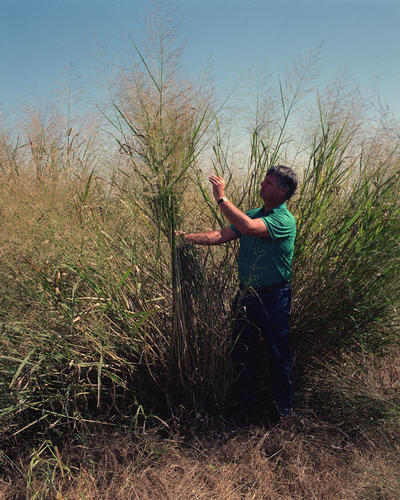
    Popular contenders for cellulosic feedstock plants are the perennial grasses such as miscanthus, switch grass and elephant grass are all C4 plants and are more efficient at photosynthesis than C3 plants.
    Miscanthus

    Switchgrass
    Additionally, their root system consist of a network of rhizomes that store energy and nutrients for the following season of growth allowing a fast regeneration time, drastically decreasing the amount of fertilizer needed and preventing soil erosion.  Further the perennial grasses under consideration are native to Amercia (including switch grass, Praries grass and Big and Little Bluegrass, suggesting that the Northern Plains and Southeastern grasslands could be a source of advanced biofuel.

    Woody perennials. 
    Woody perennials include fast growing trees such as Willow, SweetGum and Cottonwood.
    Sweet Gum


    Cottonwood
    Like the perennial grasses they have several advantages over energy crops such as corn. First the amount of biomass produced for the same land area is much greater, they have better water use, don't require fertilization and deep root systems maintain soil structure and prevent erosion.  Secondly, some species such as willow and eucalyptus are amendable to the technique of coppicing, where the plants are cut down to near ground level every 3-5 years. This allows for increased biomass and these species rapidly regenerate from the storage system contained in their roots.

    New bioenergy crops.
    With modern agricultural practices and deforestation, large tracts of land have become semi arid. Plants such as the agave that uses CAM photosynthesis, is able to grow in such conditions and could be used to regenerate these semi-arid areas while providing a biofuel feedstock. Agave plants of different species have been under cultivation for many 100's of year for alcholic beverages (think Tequila!) and for sisal fibers to use in twine, paper, dartboards (!), handicrafts and mattresses for example. Sisal fibers could be a potential source for a biofuel feedstock.

    Another problem with modern agriculture is the salinization of irrigated land and it is estimated 1-2% of irrigated land is lost every year. Highly salt tolerant plants such as prairie cordgrass and Eucalyptus species are potential feedstocks and could also be used to desalinate lost arable land.

    Waste matter 
    When I started considering biofuels from lignocellulosic feedstock, I was hopeful that a large proportion would be generated from the waste products of current industrial processes. To some extent this is true.
    Firstly there is corn stover. Stover are the leftover inedible fibrous stalks and leaves after the cobs have been harvested. It is estimated that 13.5 billions gallons of ethanol could be generated from this stover. And while the bagasse produced after sugarcane harvesting in Brazil is not used as a feedstock but is burnt and leads to production of 2giga watts net electricity, this can also be classed as biofuel, just like wood burnt in your fireplace. However the costs of collection and transportation to processing plants of corn stover and the loss of nutrients and risk of soil erosion could make this economically and environmentally untenable though this view depends on where you get the information.

    Many other crops such as wheat, rice and soybean leave a waste product called residue after the harvest. This is also a potential source of biofuel feedstock but is complicated by the same issues that are involved in corn stover collection in that the decay of the residue returns nutrients to the soil and prevents soil erosion by wind and rain. The ins and outs leading to an assessment of commerical viability are beyond the scope  of this post as they are many and complex. The 2011 US One Billion Update provides an in depth analysis of all the different aspects that need to be considered.

    Wood waste
    There are several sources of wood waste. The first if from timberland (forests used for logging) and this includes tree tops, branches, dead or rotten wood, small trees and non-commercial trees. This waste is normal left in the forest to decay but could provide a biofuel feedstock source. Careful management would be necessary as some of this waste wood provides a return of nutrients to the soil, habitats for insects and birds, fertiliser for new saplings and prevention of soil erosion.

    Other wastewood comes from forest thinning in timberland areas and non-logging forests where biomass is removed to reduce the risk of forest fires becoming catastrophic. Waste wood is also generated when timberland is converted to non-forest land such as cropland and pasture roads. A last source of waste wood is from urban wood which includes furniture, landscaping, remodeling and construction. Much of this ends up in landfills. To me, that seems like a wonderful source for generating biofuel.

    In the 2011 US One Billion Update, it is estimated that wood sources will produce up to 244 million tons of dry biomass.

    Municipal waste (MSW)
    This is the matter that everyone discards on a daily basis. Food scraps, paper waste, plastic etc.  From the point of view of biofuels, the most valuable items are paper and food. These need to be separated from the rest so despite the presence of a collection and transport system for MSW, the processing necessary in order to use it commercially as biofuel feedstock, is complicated. 

    Animal Fat and Yellow grease.
    Animal fats are generated from the slaughter of animals. However they are less valuable as a feedstock as they have a tendency to crystallize at lower temperatures. Yellow grease is the oil left over after cooking for example in restaurants and is a mixture of plant and animal fats. It is in limited supply but could be commercially viable for smaller biofuel operations.

    The table shows the total and projected tons of biomass available from different feedstocks for ethanol and biodiesel (from 2011 US One Billion Update)


    Current commercial operations
    According to Environmental Leader, there are 11 competitive cellulosic ethanol plants currently operating and use of cellulosic feedstocks will be cost competitive with corn as a feedstock by 2016 and in fact many corn based plants are shutting down due to eroding profit margins. Wikipedia provides a table showing several companies in the US, their start dates and production capacities. A selection is shown in the table below and the feedstocks show that corn stover, wheat straw, wood waste and municiple waste are among the main ones in use.


    Company Location Feedstock Capacity (million gal/year) Began Production Type
    Abengoa Bioenergy Hugoton, KS Wheat straw 25 - 30 [33][34] est. late 2013 Commercial
    DuPont Nevada, IA Corn stover 30[41] est. 2014 Commercial
    Fulcrum BioEnergy Reno, NV Municipal solid waste 10 est. end of 2013 Commercial
    Gulf Coast Energy Livingston, AL Wood waste 0.3 [42] before 2008 Demonstration
    Mascoma Kinross, MI Wood waste 20 est. 2014 Commercial
    POET LLC[43][44] Emmetsburg, IA Corn stover 20 - 25 est. lat 2013[45] Commercial
    POET LLC[46] Scotland, SD Corn stover 0.03 2008 Pilot


    Concluding...this post
    Cellulosic feedstocks are on a roll and there are many sources. I hope to have a closer look at these in coming posts and to bring in the bugs!

    References and websites used:
    Youngs and Somverville  2012, Development of feedstocks for cellulosic biofuels. F1000 Reports Biology. Volume 4, Issue 10.
    Environmental Leader
    Bloomberg New Energy Finance
    Biofuels Digest
    US One Billion Update
    Wikipedia; various